


Glass, dark, cool, sealed. That covers most of it. But each format fails differently, and the mistakes that ruin flower aren’t the ones that ruin a disposable.
Here’s what actually degrades each thing you might have bought, and what to do about it.
The four things that degrade everything
Whatever the format, the same four forces are working against it:
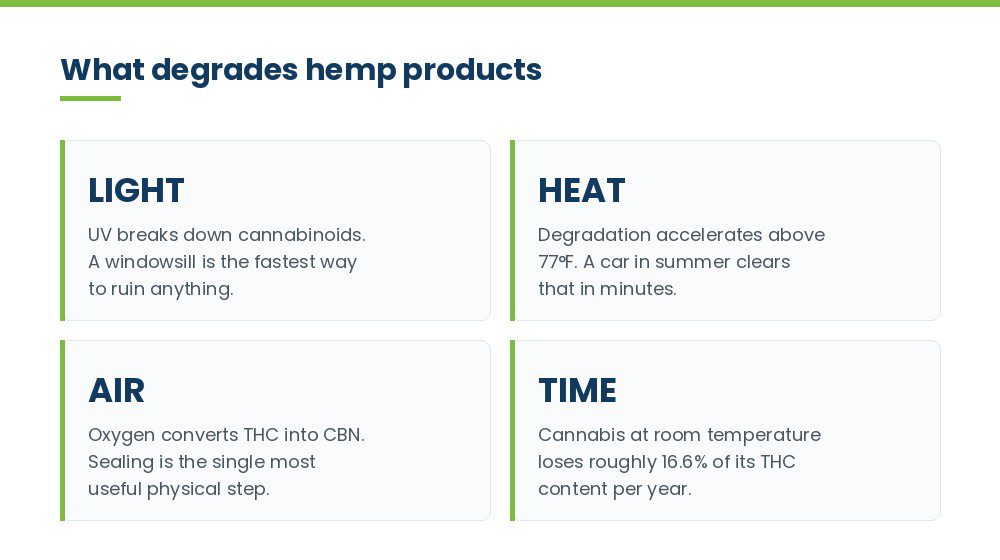
- Light. UV breaks down cannabinoids. A windowsill is the fastest way to ruin anything.
- Heat. Degradation accelerates noticeably above 77°F. A car in summer clears that in minutes.
- Air. Oxygen converts THC into CBN, a different cannabinoid altogether. Sealing is the single most useful physical step.
- Time. Research cited by the UNODC found cannabis stored at room temperature loses roughly 16.6% of its THC content per year. Storage slows that; nothing stops it.
Everything below is an application of those four.
Flower and pre-rolls
Flower is the most demanding format because it’s the only one where humidity matters.
Container: airtight glass. A mason jar works. Amber or opaque glass is better because it blocks light. Avoid plastic bags — static pulls trichomes off the bud, and some plastics off-gas into the terpenes.
Humidity: 58% to 62% relative humidity. Below 55% the flower goes brittle and smokes harsh. Above 65% you’re risking mold. Two-way humidity packs like Boveda or Integra Boost hold the range automatically — one per jar, replaced every two to three months.
Temperature: 60 to 70°F, in a dark cabinet or drawer.
Jar size matters more than people think. Empty headspace is oxygen. An ounce in a small jar keeps better than the same ounce in a large one.
Pre-rolls follow the same rules. If yours came in a sealed tube, that tube is a decent container — keep it closed.
Edibles
Simplest format to store and the easiest to wreck with heat.
Keep gummies in their original packaging, sealed, at room temperature and out of light. The child-resistant packaging exists for a reason and doubles as a decent barrier.
Heat is the enemy here in a literal way: gummies melt, fuse together, and once they’ve melted and re-set, the cannabinoid distribution across the pack isn’t what the label says anymore.
The refrigerator works, but condensation forms every time you open the pack. If you refrigerate, let the pack come to room temperature before opening it.
Concentrates
Cold, dark, airtight, and in glass or silicone rather than plastic.
Rosin is the most sensitive thing you can own. Terpenes are volatile, and warm rosin loses them fast. For anything you’re not finishing within a few weeks, the refrigerator is the right call — and cold rosin is stiff, which is fine, since you’re going to warm it before use anyway.
Keep syringes capped and upright. Concentrate follows gravity.
Disposables and cartridges
Different failure modes from everything above, and mostly about temperature swings.
Store them upright. Laid flat, oil migrates toward the mouthpiece and can leak or flood the coil.
Room temperature, not cold. Cold oil thickens, which makes it hard to draw and can burn the coil while you pull harder to compensate. Cold also stresses the battery.
Never leave one in a car. Heat thins the oil until it leaks past the seals. This is the most common way a good device dies.
Don’t store one fully drained. A depleted lithium battery left for months may not take a charge again.
The mistakes that cost the most
- A windowsill or a car. Light and heat together. Nothing degrades faster.
- Plastic bags for flower. Fine for a few weeks. After that, transfer to glass.
- The freezer. Trichomes go brittle and break off, and every thaw brings condensation.
- An oversized jar. Headspace is oxygen you’re storing along with the flower.
- Storing near strong-smelling things. Coffee and spices transfer. Terpenes absorb.
How long things actually last
Hemp products don’t spoil the way food does. They degrade — cannabinoids convert, terpenes evaporate, flavor flattens.
Flower stored properly — sealed glass, humidity pack, 60 to 70°F, dark — holds most of its quality for six to twelve months and stays usable well beyond that. The same flower on a warm shelf in a plastic bag can lose noticeable quality in weeks.
Concentrates and edibles are more stable than flower as long as they stay sealed and cool. Disposables are limited less by the oil than by the battery.
What we carry, by format

Flower and pre-rolls need the humidity control. Edibles just need to stay sealed and cool. Concentrates want cold and dark. Disposables want upright and room temperature.
Every batch we sell ships with a third-party lab report on our COA page — worth checking what you started with, since storage only determines how much of that you keep.
Frequently asked questions
What humidity should hemp flower be stored at?
58% to 62% relative humidity. Below 55% it dries out and smokes harsh; above 65% you risk mold.
Can I store flower in the refrigerator?
It’s workable but not ideal. Humidity fluctuates and condensation forms each time you open the container. A cool dark cabinet at 60 to 70°F is better.
Can I freeze hemp flower?
Not recommended for normal storage. Freezing makes trichomes brittle so they break off, and thawing introduces moisture.
Why shouldn’t I keep flower in a plastic bag?
Static from the plastic pulls trichomes off the bud, and some plastics off-gas into the terpenes. Fine for a few weeks; transfer to glass after that.
How should I store a disposable vape?
Upright, at room temperature, out of direct light. Not in a car, and not fully drained for long periods.
How long does hemp flower stay good?
Stored properly, six to twelve months at full quality and usable beyond that. Stored badly, quality drops in weeks.
Do edibles need refrigeration?
No. Sealed, at room temperature, out of light is enough. If you do refrigerate, let the pack warm before opening to avoid condensation.
This article is for general information and is not legal or medical advice. Hemp regulations vary by state and change frequently.