


A single disposable can list four cannabinoids on the box. A gummy might list three. The names run together into alphabet soup, and almost nothing explains what any of them actually are.
Here’s the plain version: what each one is, which occur naturally in the plant, which are made in a lab, and why that distinction matters more than most of the marketing around them.
THCA — the one that changes
THCA is the acidic precursor to THC, and it’s what the raw plant actually produces. In its unheated form it isn’t intoxicating.
Apply heat — a lighter, a coil, an oven — and a carboxyl group breaks off. That reaction is called decarboxylation, and it turns THCA into Delta-9 THC. The molecule also loses a bit of weight in the process, which is where the 0.877 conversion factor on a lab report comes from. We walk through that calculation in our COA guide.
So THCA flower isn’t a different kind of THC. It’s THC that hasn’t converted yet.
Delta-9 — the reference point
When someone says “THC” without qualifying it, they mean Delta-9. It’s the best-known form and the benchmark everything else gets measured against.
Structurally, it has a double bond on the ninth carbon of its chain, and a five-carbon alkyl side chain. Those two details are what the other cannabinoids on this list vary.
Delta-8 and Delta-10 — same formula, different position
Delta-8 has the identical molecular formula to Delta-9. The only difference is where the double bond sits: the eighth carbon instead of the ninth. Delta-10 moves it again.
That single positional change alters how the molecule fits into cannabinoid receptors. It’s a small structural difference with a real consequence, which is why they’re sold as separate products rather than as variations of the same thing.
Worth knowing: the plant produces almost no Delta-8 on its own. Nearly all commercial Delta-8 is converted from CBD through a chemical process called isomerization.
THCP — the long side chain
THCP was identified by Italian researchers in 2019. Structurally it’s close to Delta-9, with one significant difference: its alkyl side chain has seven carbons instead of five.
Those two extra carbons let the molecule sit deeper in the CB1 receptor. Laboratory measurement put its binding affinity at up to 33 times that of Delta-9.
That 33x figure gets repeated everywhere, and almost always incorrectly. It describes how tightly the molecule binds to a receptor in a laboratory measurement. It is not a claim that a product is 33 times anything for a person using it. Binding affinity and consumer experience are different things, and the amount of THCP actually present in a product — usually a fraction of a percent — matters far more than the ratio.
If a shop tells you a device is “33x stronger,” they’re misreading a research paper.
HHC — the stable one
HHC is hexahydrocannabinol. Take THC and add hydrogen atoms to the molecule — the same basic idea as hydrogenating an oil — and the result is a more chemically stable compound that degrades more slowly.
That stability is the point. It’s also why HHC is always made by conversion: the plant doesn’t produce it in any meaningful quantity.
The distinction that actually matters
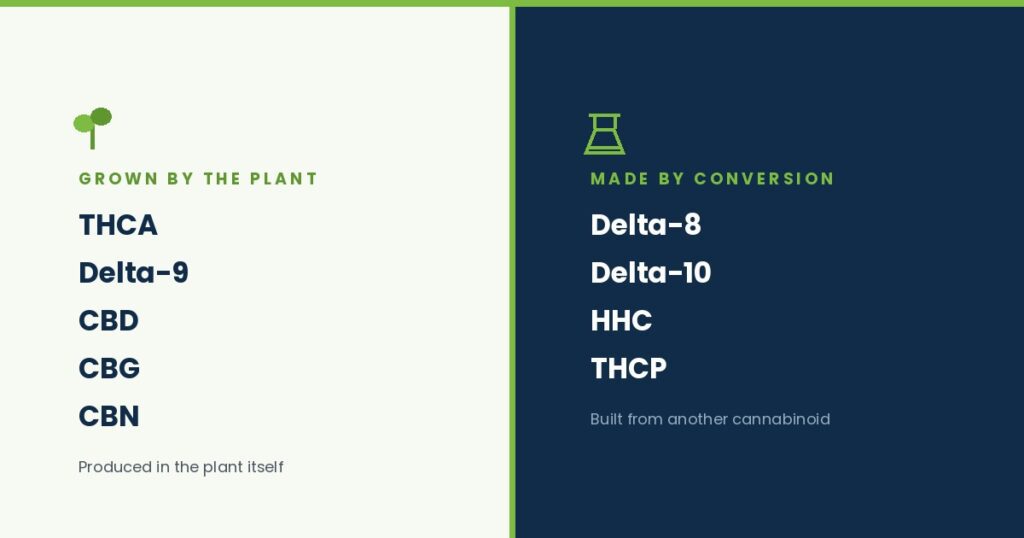
Forget the alphabet for a moment. The more useful split is this:
Naturally produced by the plant: THCA, Delta-9, CBD, CBG, CBN.
Made by chemical conversion: Delta-8, Delta-10, HHC, acetate forms, and commercially, THCP.
Conversion isn’t inherently bad. But it’s a chemical process, and chemical processes can leave byproducts, residual solvents or incomplete reactions behind. A converted cannabinoid made carelessly is a different product from one made properly, and you cannot tell them apart by looking.
That’s the practical reason the lab report matters more on converted cannabinoids than on flower: the residual solvent panel and the full cannabinoid breakdown are the only places the difference shows up.
What’s in what we carry
Most devices layer several of these rather than running one:
- THCA alone: flower, plain pre-rolls, and the Loud rosin line
- Liquid diamonds: Big Chief‘s Duo and Boutiq‘s Switch
- THCA, THCP and Delta-9: HiXotic‘s Trap’d Out Jeffrey
- THCP with HHC: Muha Meds Gen 3
- THCA with Delta-8: Cake‘s 3G devices
- THCP on its own: Ice Kream cones
- Delta-9 with CBD, 1:1: Kush Kube gummies
Two products at the same price and capacity can be built on completely different chemistry. The blend is in the small print on the box, and always on the lab report.
How to check what you’re buying
The cannabinoid table on a COA lists every compound detected with its measured concentration — not what the marketing says, what the lab found.
Three things to look at:
- Which cannabinoids are actually present, and in what amounts
- Total THC, calculated as Delta-9 plus 0.877 times THCA
- The residual solvent panel, which matters most on converted cannabinoids
Every batch we carry has a report on our COA page.
Frequently asked questions
Is THCA the same as THC?
Not until it’s heated. THCA is the acidic precursor the plant produces. Heat converts it to Delta-9 THC through decarboxylation.
What’s the difference between Delta-8 and Delta-9?
The position of one double bond — the eighth carbon instead of the ninth. Same molecular formula, different shape, which changes how it fits into cannabinoid receptors. Most commercial Delta-8 is converted from CBD.
Is THCP 33 times stronger than THC?
No. The 33x figure describes receptor binding affinity measured in a laboratory, not consumer experience. How much THCP is actually in a product matters far more than that ratio.
What is HHC?
Hexahydrocannabinol — THC with hydrogen added to the molecule, which makes it more chemically stable. It’s produced by conversion rather than grown.
Which cannabinoids occur naturally?
THCA, Delta-9, CBD, CBG and CBN are produced by the plant. Delta-8, Delta-10, HHC and commercial THCP are made by chemical conversion.
Why does it matter if a cannabinoid is converted?
Conversion is a chemical process, and chemical processes can leave byproducts or residual solvents. The lab report is the only place to verify what ended up in the finished product.
How do I know what’s in a product?
Read the cannabinoid table on its batch COA rather than the front of the package.
Check any batch on our COA page →
This article is for general information and is not legal or medical advice. Hemp regulations vary by state and change frequently.